The Identity of My Non-Place
Doctoral series, 2024
stone lithography
That which hurts and moves to the depths, that which marks and stigmatizes, that which is a scar and a stinging wound tips the experience of a place that is lined with anxiety. A fragment torn by silence, ruptured by that which is incoherent and incomprehensible, spreading open to the infinite […]
A. Kunce
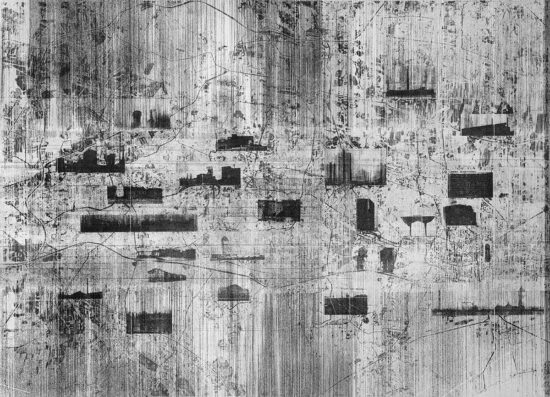
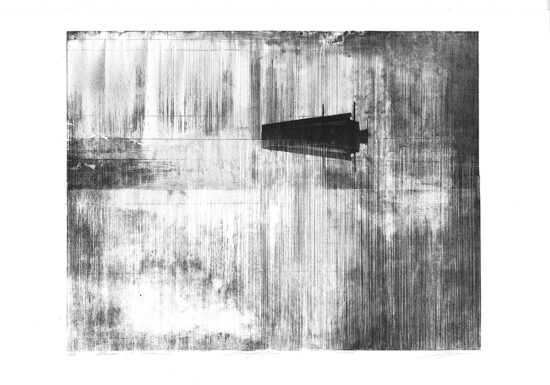
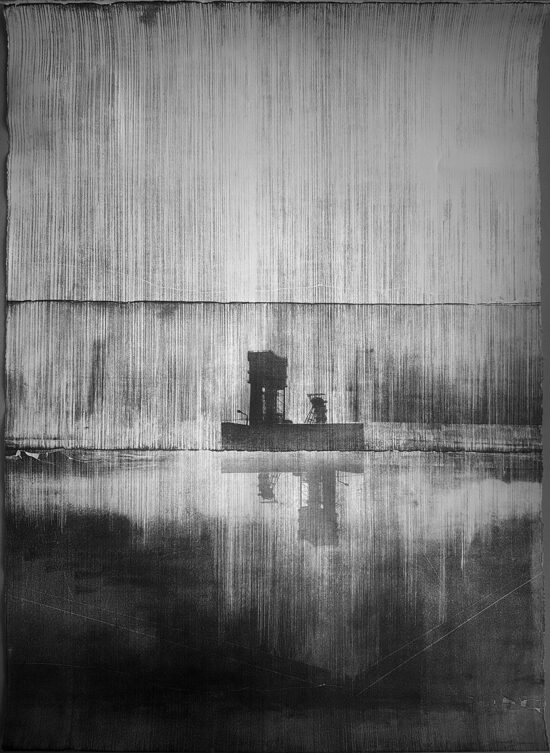
The graphic series My Non-Places talks about places I know from my childhood. The images in my work are a bit like mental maps – landscapes in my head, constructed from other images, colors, tones, memories or old photographs. I treat them as palimpsests of traces of old memories, spaces of childhood. The places I evoke in the prints exist or existed in reality, but they are significantly different from the images I evoke in my head. They are therefore marked by the fabric and imaginative palimpsest of my memories, the spirit of the times and the process of memory fading, combined with the added value I have evoked from my imagination. They are places that have stuck deep in my memory, places where I grew up, where I spent time. Recalling them evokes emotions in me. I cannot say why I return to these locations in my mind, but in doing so, I feel nostalgic. For my childhood, for a carefree time, for my world. I know that in my mind I have, in a•way, created them anew. I have created new images. To physically return to them beyond emotional emotion would cause me disappointment, remembering them differently, because in my memory they will always be bigger, more beautiful than they really are, timeless. And I will always be able to escape to them.
The concept
We humans are social beings who, in the search for our identity, associate ourselves with the places they come from, where they were born, raised, inhabited. All these places are objects of memory. I believe that the most important place for every human being is where they grew up. It is the place that shapes us most strongly. When I speak of mental space, I mean a place that is familiar to us from our childhood, clearly stored in our memory, which we begin to idealise. In this process, the image we create becomes a separate space, existing only in our mind. We build our identity from memories, imaginings, creating patchwork constructions of mental images that are the layering of old and new meanings of our existence. Images from the past are the mine of the cultural reality that has shaped us. Space binds us together in many ways – whether by growing up in a certain community, being shaped in a certain culture, being brought up in a certain environment, or finally, by shaping places of memory. It is memory that shapes the knowledge of where we come from, who we are. Memory creates the memories that our imagination transforms.
We live in a time of simultaneity in the understanding of space, a simultaneous sense of proximity and remoteness, of blurring boundaries, of displacement. The context of place in the 21st century has largely changed its meaning. We live, as it were, located in time, less and less attached to the place where we live at any given moment, while feeling much more strongly attached to the places where we come from, where we grew up. Speaking of space, it is impossible not to refer to Marc Augé’s philosophy of the experience of space with his category of non-lieux, non-place. “These are all spaces that are the antithesis of home, a space that is tamed, oriented, personalised, that has a history and an accumulated memory.” Space, in this sense, is the space of human experience that marks the human being.
The question of identity is linked to the dynamics of change in the reality around us or to coexistence in different cultural circles. We observe shifts in concepts such as Marc Augé’s non-lieux, Stijn Reinders’ lieux d’imagination, Pierre Nora’s lieux de mémoire or Michel Foucault’s heterotopias. We are suspended between dwelling and travelling, because it is travel that has become a particular factor in valuing questions of identity that are part of the philosophy of locality. We have become citizens of a world whose traces of origin are slowly disappearing; we move towards a suspension between what we remember from our childhood and the reality we live in now. Sometimes this space almost loses its physical characteristics and becomes virtual, situating itself, as it were, in opposition to the idea of locality, associating itself with concepts such as from anywhere, from everywhere, from nowhere. However, human nature will always direct us to the source, to the roots, because the familiar, the surrounding, the local, provokes a•confrontation with the infinite, the limitless, from everywhere.
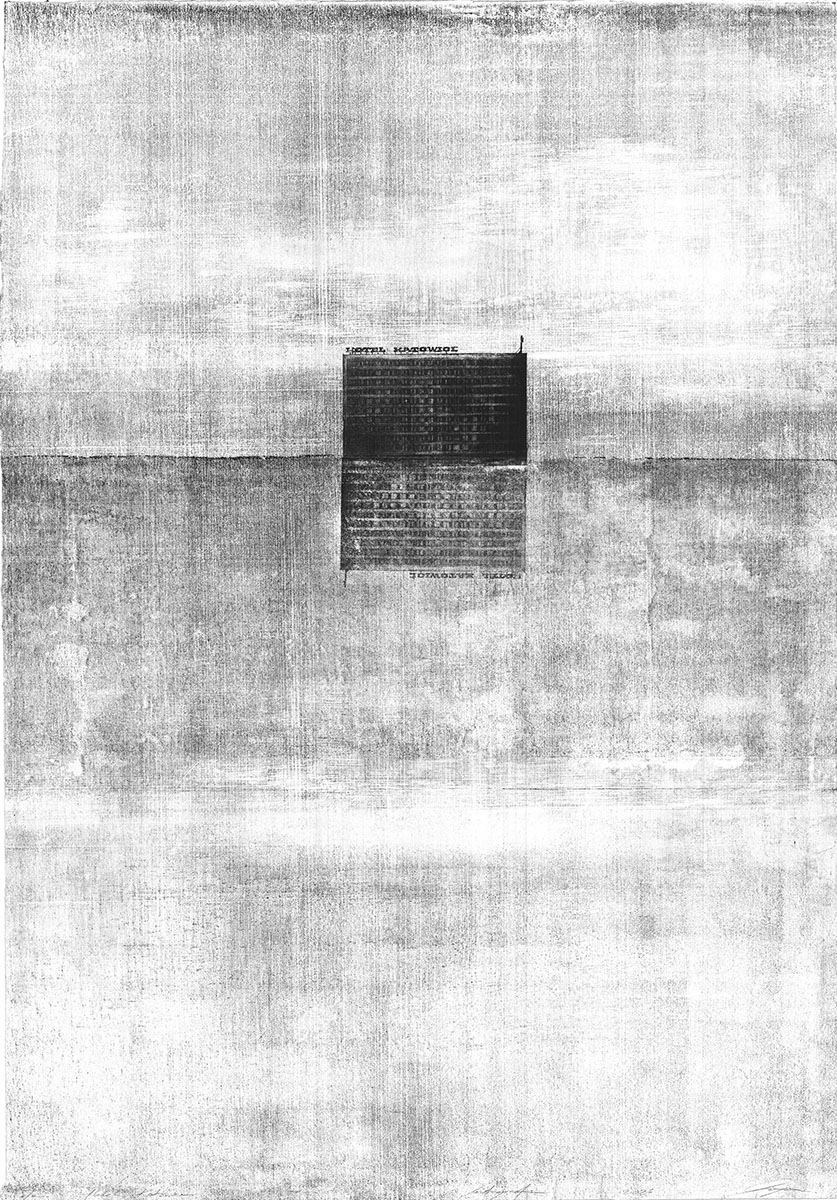
Hotel Katowice
stone lithography, 100 × 70 cm, 2024

Mikołowska
stone lithography, 112 × 76 cm, 2024
Certificate of Merit, 12th All Women Artists’ Exhibition, Chandigarh, India, 2026

Katowice Railway Station
stone lithography, 100 × 70 cm, 2024

Uthemann Steelworks
stone lithography, 100 × 70 cm, 2024

Zabrze
stone lithography, 100 × 70 cm, 2024

Szopienice
stone lithography, 100 × 70 cm, 2024

Spoil Heap
stone lithography, 100 × 70 cm, 2024

Wujek Coal Mine
stone lithography, 100 × 70 cm, 2024

Tysiąclecia Housing Estate
stone lithography, 112 × 76 cm, 2024

Koleje Śląskie
stone lithography, 100 × 70 cm, 2024