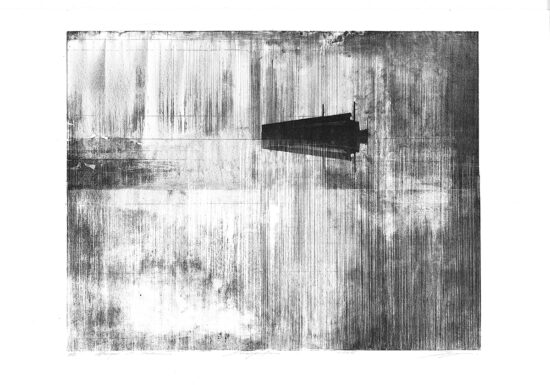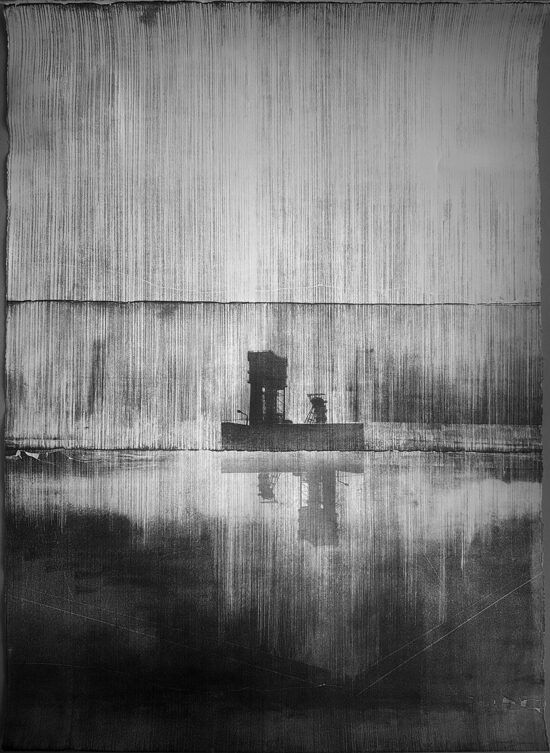
Architectures of Absence is an extension of my ongoing cycle Silesia Memoria, bringing together a set of large-format stone lithographs that examine postindustrial Silesia (Poland) through the lens of architecture, memory, and spatial displacement. The project combines two cartographic lithographs from the Silesian non-places series with a wider group of site-based lithographs from Silesia Memoria – images of coal mines, railway infrastructure, worker estates, and industrial remnants that continue to shape the region’s fractured identity.
Drawing from Marc Augé’s theory, non-places are commonly understood as spaces of transience – deprived of stable memory, history, and relational meaning. Yet in Silesia, these sites-abandoned mines, power plants, railway depots, and industrial buildings – retain the silent imprint of human labor and social transformation. By locating specific architectural remnants and recording their traces, the works construct an alternative cartography of dislocated architecture: places that fall outside dominant narratives of heritage, yet are not fully erased from collective experience.
All works are created using traditional stone lithography – a technique historically used to reproduce maps and technical images. Here, the lithographic workshop and its analog processes are integral to the meaning of the project: the stone matrix, with its texture, imperfections, and chemical traces, becomes part of the narrative. The result is an architectural portrait of a region told through its absences – images that register what remains, what disappears, and what persists as residue.
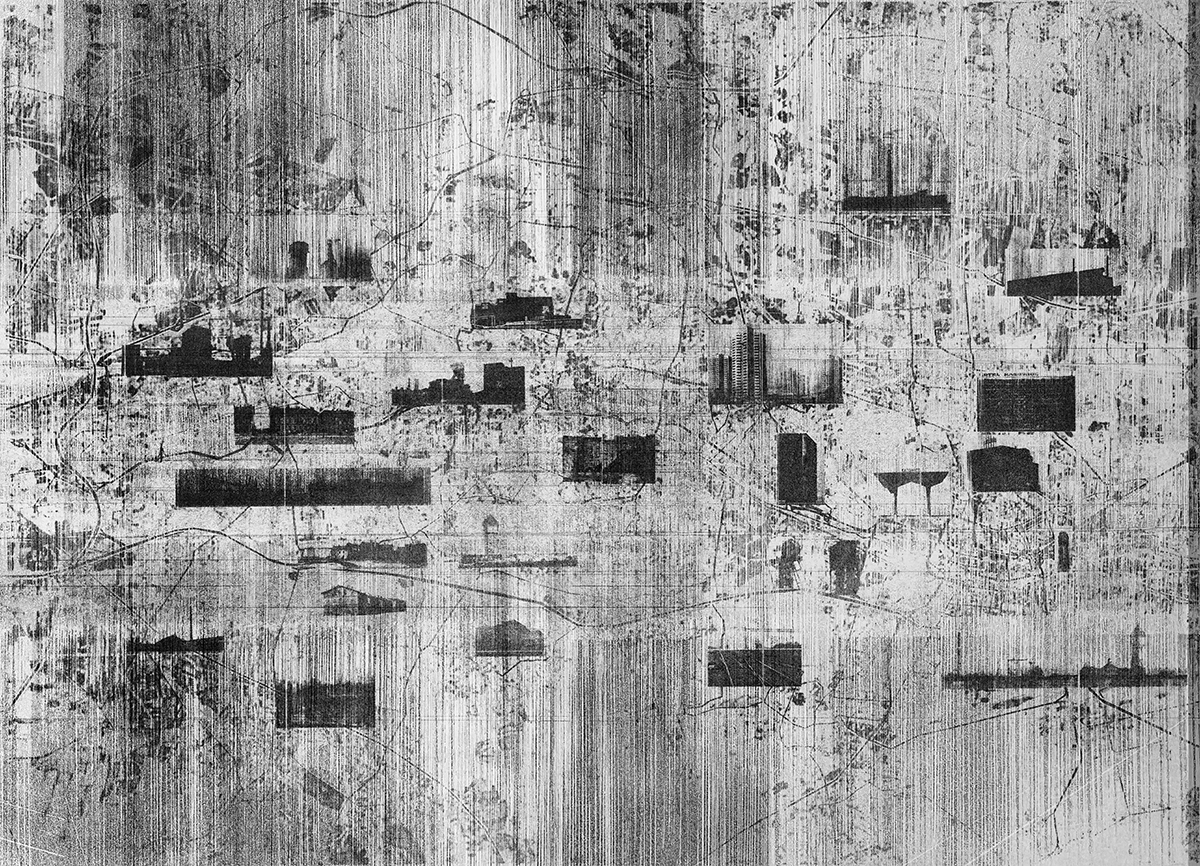
Map I — “The Map” (Silesian non-places)
The first cartographic lithograph establishes a readable territorial framework. It presents the map of Silesia as a system of coordinates in which selected images from the Silesian non-places series are positioned and anchored. The work functions as an index: it locates specific sites (e.g., Katowice, Gliwice, Zabrze, Ruda Śląska, Chorzów) and fixes them within the logic of mapping – making visible a network of places that are often experienced as peripheral, transitional, or socially “unassigned.”
Map II — “The Non-Map” (Silesian non-places)
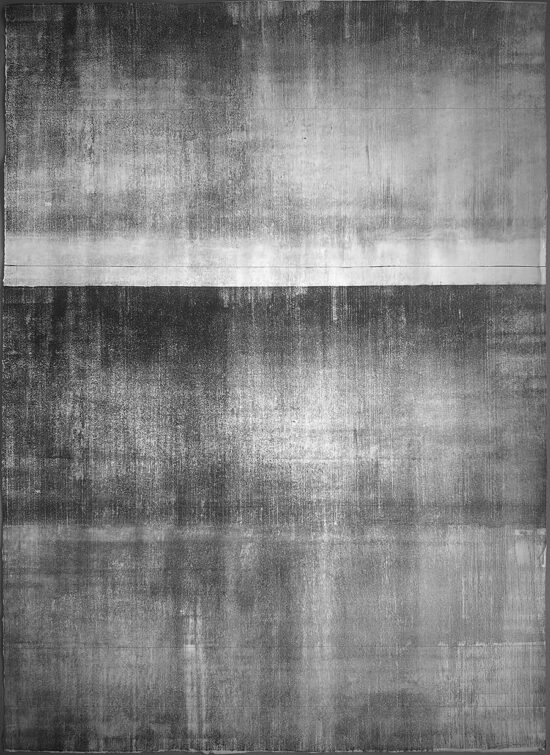
The second cartographic lithograph complements the first by destabilizing orientation. It presents the same territory, but the map is overlaid with sketch-like architectural imprints referencing technical drawings, archival floor plans, and functional annotations. This layer reveals what lies “beneath” the mapped surface: the utilitarian logic and structural “bones” of industrial non-spaces, and the shift from function to semantic void. It acts as a reverse side of the first map – an interpretative palimpsest that allows the viewer to perceive what has been lost, displaced, or rendered invisible.
Together with the site-based lithographs from Silesia Memoria, the two maps frame the project as a dialogue between documentation and erasure, surface and structure, presence and absence.
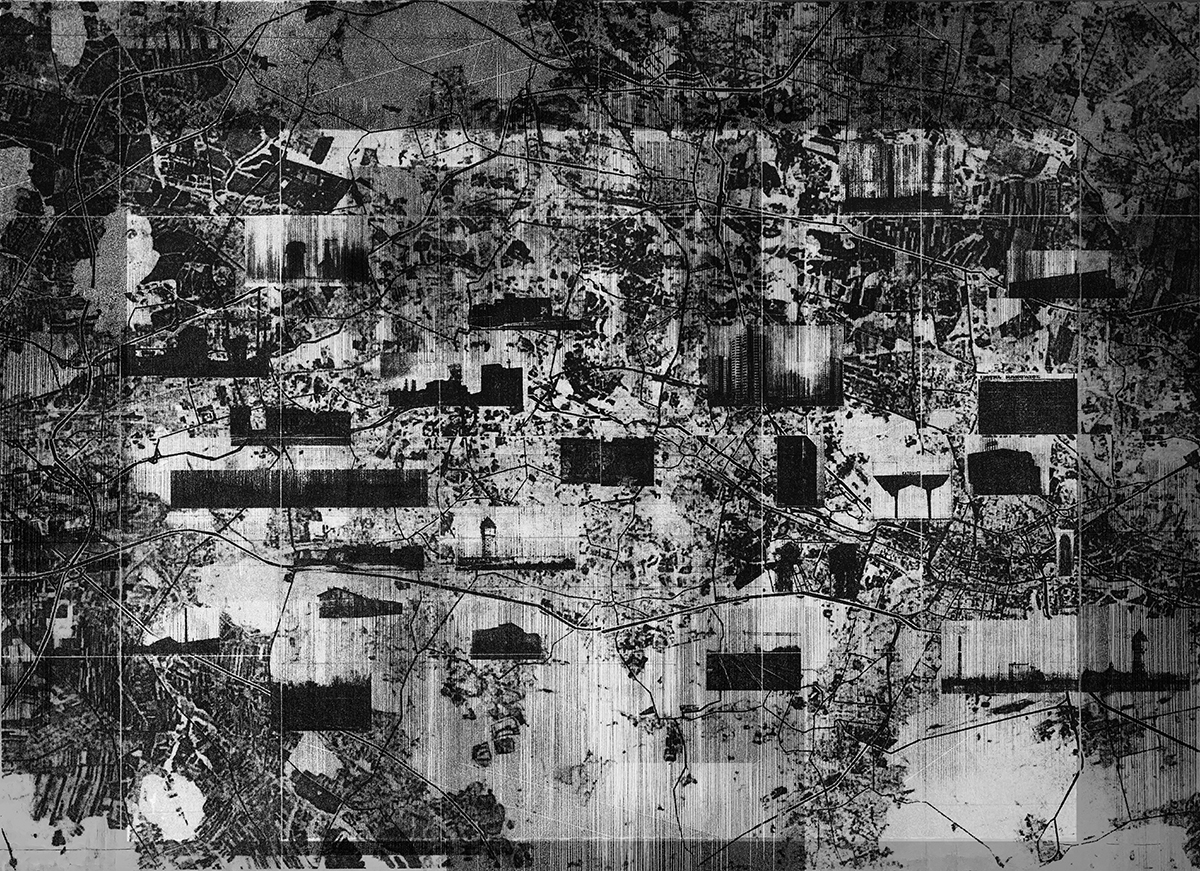
Map I
stone lithography, 70 × 100 cm, 2025
Map I state II.
stone lithography, 70 × 100 cm, 2025
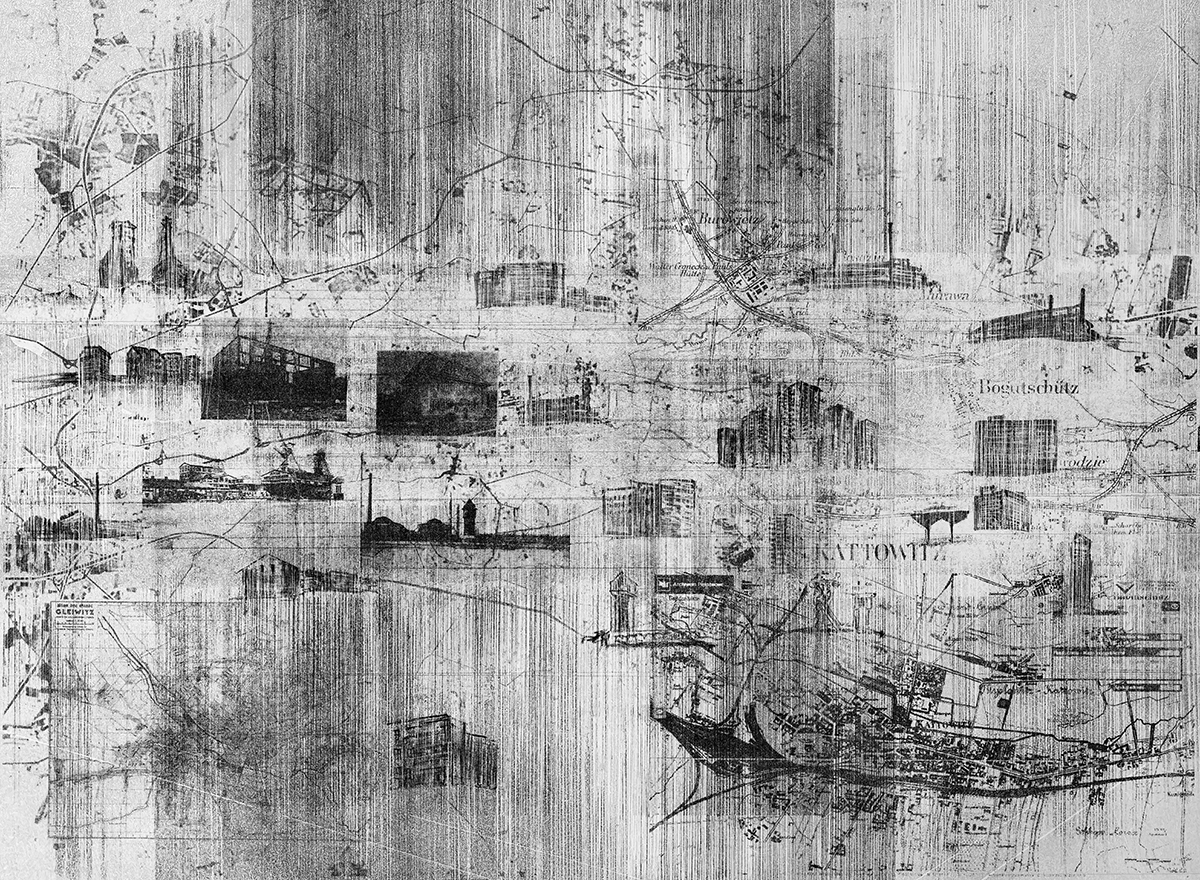
Non-Map
stone lithography, 70 × 100 cm, 2025