My Lithography Process
film, 7:43
The process
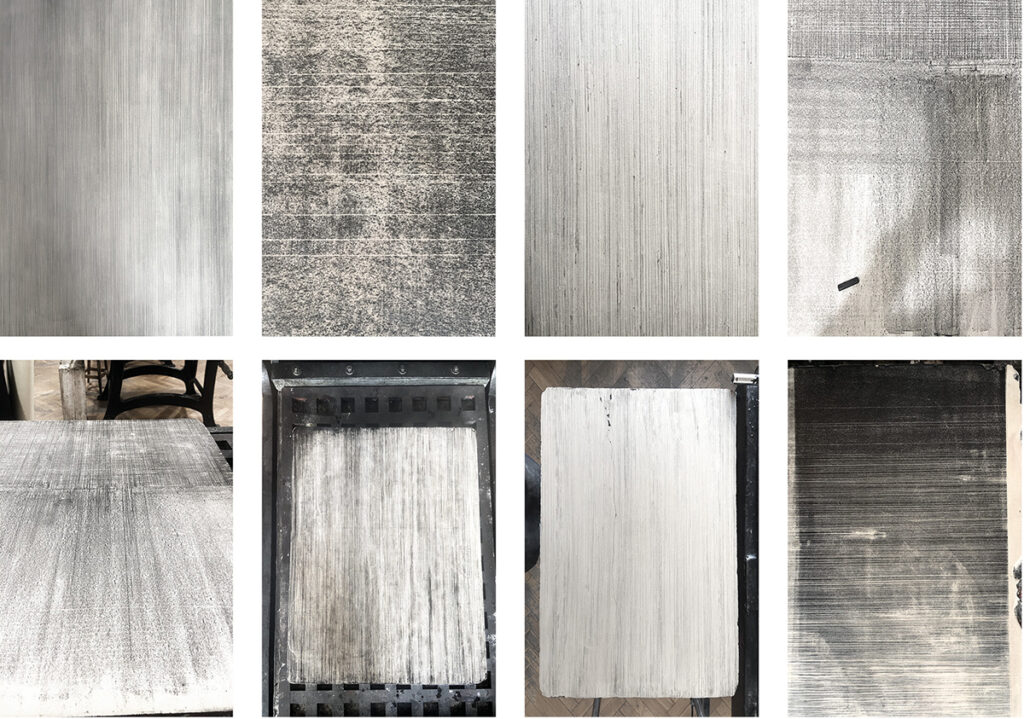
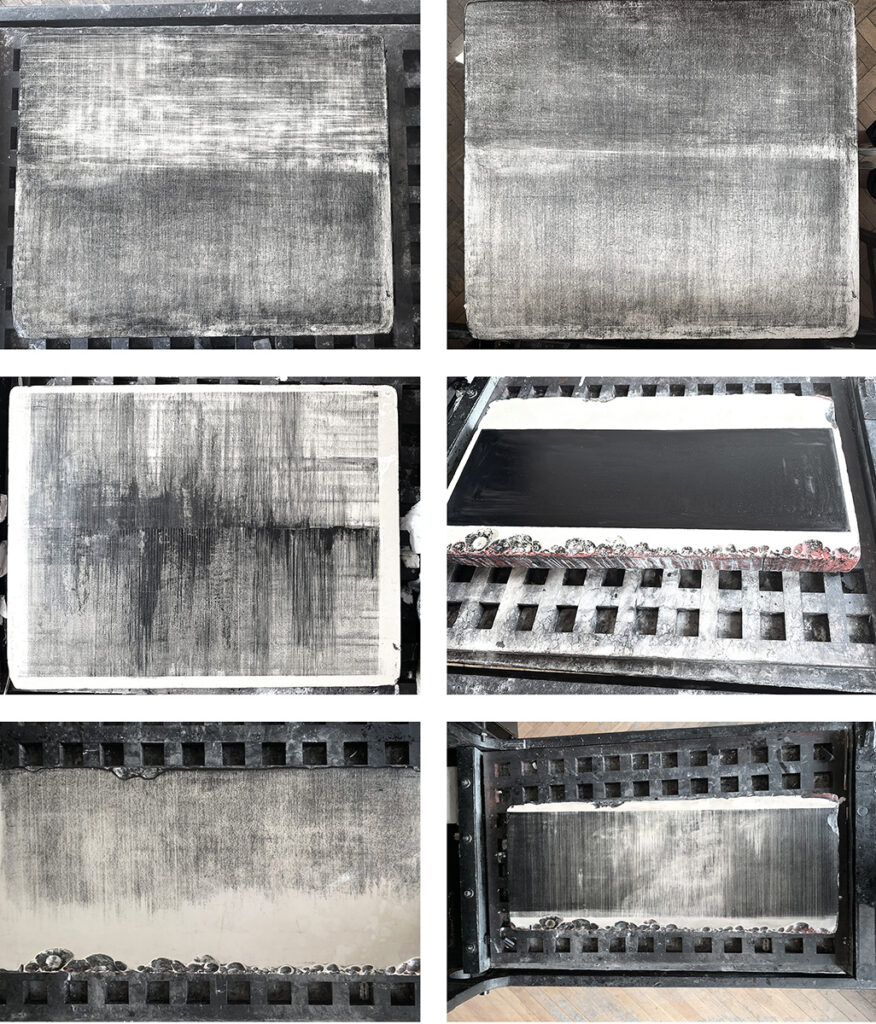
I remain to work in the traditional technique of lithography – I draw mainly with crayon and lithographic ink and with the technique of scratching in stone. By scratching out a repetitive rhythm of lines on the stone matrix, I am able to operate on the smallest nuances, using the grene or any scratches and cracks in the stones. Thanks to the rhythm of the lines, I am able to achieve a neutral lithographic grey, enhancing the feeling of transparency and transience of a given representation, viewed as if from behind the obscurity of the vertical cut lines on the stone. By multiplying and superimposing individual matrices in the printing process itself, I generate a kind of noise, a jittery grey raster aplomb, a semi-transparent tissue, superimposing it on the composition of landscapes of places that I build into the paintings in abstract forms.
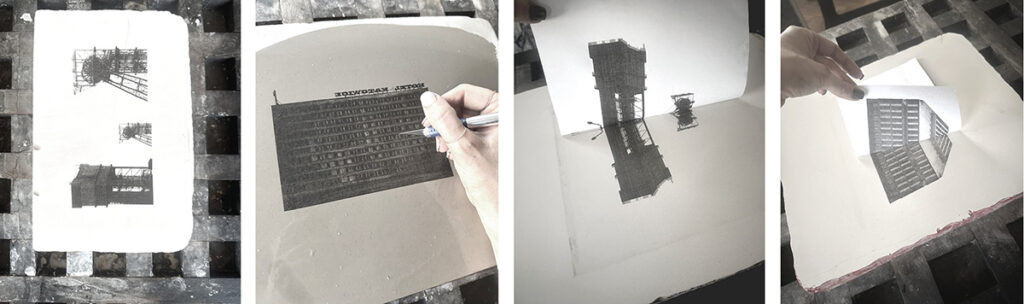
When starting to work on a print, I see the space I want to evoke, the image emerges by applying more and more layers and sometimes even blank prints (without applying fresh ink). Each print is made up of several or even a dozen prints in which I build up value through the multiplicative nature of the print. Although the rhythm of the lines, the multiplication of layers form the background to the architectural forms taken from the photographs, they overwhelmingly override the complementary architectural form of my non-places. It is this fabric of the background that becomes animated, vibrating, smouldering, alluding to the fabric of life, memories, experiences, emotions that the memory of the given places evokes in opposition to the rawness and dead matter of the architectural photographs reprinted from smaller stones. By multiplying the prints in question, I create some kind of palimpsest of the places I talk about, layering them, marking them with successive layers of meaning – like maps of the web of connections of memories and emotions that I see in the images. I use elements in my work that could be considered flaws – cracks in the stone, cracks, a unique edge, which I often reflect on graphic prints in a similar way to ‘die cutting’ – the same way the edges of the stone cut my subsequent graphic prints. Reproducing the shape of the stone repeatedly is a kind of matrixing of the graphic print, as it makes its trace visible. For me, the creation of ephemeral images is strictly conditioned by the dual nature of printmaking.
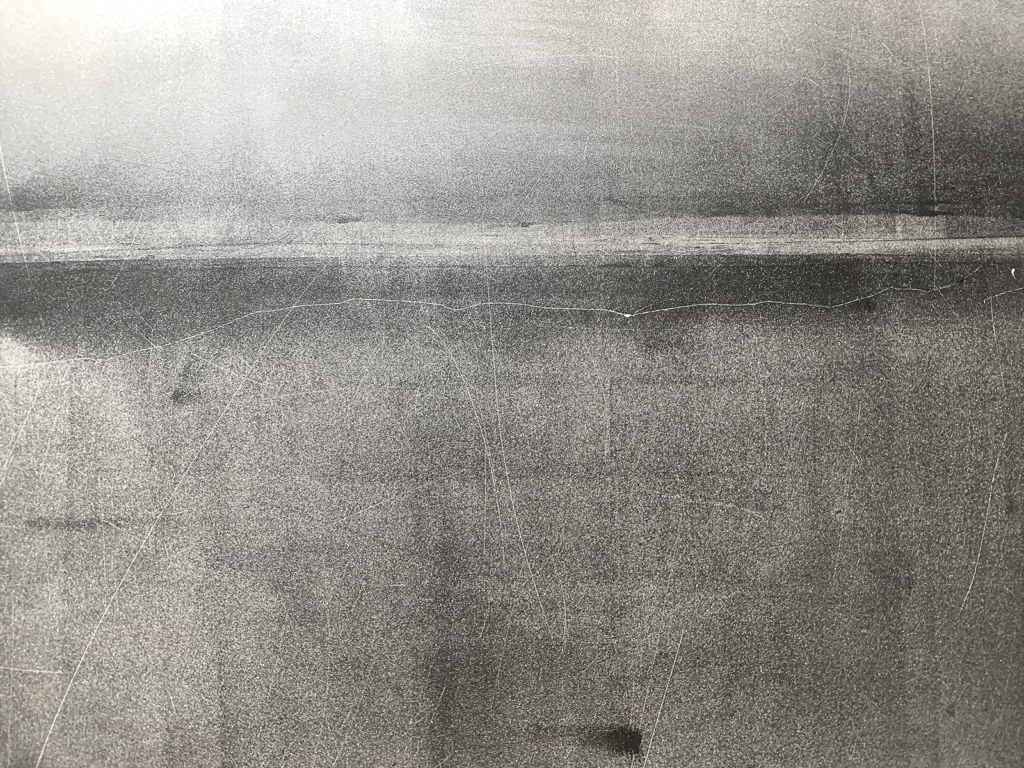
My actions and creative strategies are related to both the stage of working on the matrix, the printing stage and the final formation of the graphic fabric of the work. The final stage is the structuring of the work – reprinting the architectural elements that are or were actually in the particular space I want to ‘draw’. The composition is almost always open-ended, printed off the edge of the paper or matrix – on the one hand, it leaves the viewer with the feeling that the graphic is only a slice of a larger space; on the other hand, the viewer can find a continuation of the given composition in the subsequent graphics of the series, and can even juxtapose the graphics in infinite ways. Moreover, each graphic is designed so that it can be turned 180 degrees according to the horizon line, mixing the worlds below and above as an obvious reference to what is below ground, belonging to the past, memories, places faded in memory, with what is above, what is superior as a preposition locating a given thing in space or creating expressions denoting temporal proximity – belonging to actual images, clearer graphic forms. The series thus has an infinite number of solutions, and can be read in many ways, each time revealing a different narrative.